The Different Stages of Colon Cancer
If you have colon cancer, your doctor will determine the stage of your disease. Doctors use biopsy results and imaging tests like CT scans to stage colon cancer. The stage describes the severity of your cancer.
The stage of your cancer depends on:
- How deep it is in the wall of your colon
- Whether your lymph nodes are affected
- Whether the cancer has spread to other organs
Staging is essential. Your doctor uses this information to plan your treatment. Staging also helps your doctor predict the outlook for your condition and the likelihood that your treatment will be successful.
Understanding Colon Cancer Stages
There are five stages for colon cancer. They're numbered using Roman numerals: 0, I, II, III and IV. Higher numbers indicate more severe disease.
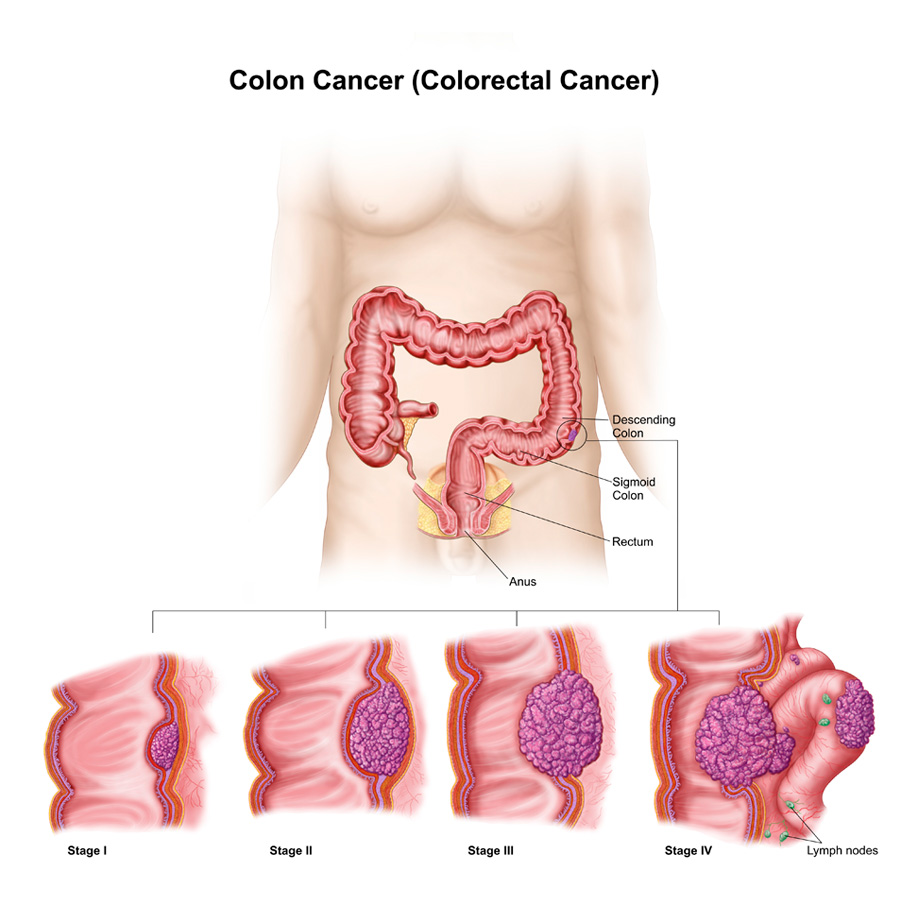
Stage 0: These are early cancers. The cancer does not go beyond the lining of the colon or rectum. Doctors can remove some stage 0 cancers during a colonoscopy. Otherwise, you will need surgery to remove the cancer. Stage 0 colon cancer may not require any other treatment.
Stage I: These cancers have grown deeper into the lining of the colon. However, they have not spread beyond the colon or into the lymph nodes. You will need surgery to remove the cancer. Your doctor will also remove the part of the colon where the cancer is found. Treatment is likely to be successful.
People with stage I colon cancer have what's called a five-year relative survival rate of 92%. This means that people who have it are about 92% as likely to live for at least five years after their diagnosis as people who don’t have cancer.
Stage II: These cancers have spread to the outside layers of the colon. They also may have made a hole in the wall of the colon and grown into nearby tissues or organs. Stage II cancers have not affected the lymph nodes. You will need surgery and you may also need chemotherapy. Treatment is still very effective. The five-year relative survival rate ranges from 63% to 87%.
Stage III: These cancers are advanced. The cancer has spread from the colon to the lymph nodes. However, stage III cancer has not affected other organs. You will need surgery to remove the cancer. You may also need chemotherapy and radiation treatment. Some people with stage III colon cancer are not healthy enough for surgery. In that case, doctors treat the cancer with chemotherapy and radiation. The five-year relative survival rate ranges from 53% to 89%.
Stage IV: These late-stage colon cancers have spread beyond the colon to other organs in the body. Stage IV colon cancer usually has spread to the liver. Colon cancer may also spread to the lungs, ovaries or lymph nodes in other parts of the body.
Doctors can sometimes remove stage IV cancers with surgery. You may need other treatments, too, depending on where the cancer has spread. However, treatments are less likely to cure stage IV colon cancer. Instead, chemotherapy and radiation may help prevent complications and help you live longer. The five-year relative survival rate for stage IV colon cancer is 11%.
Staging is an important way to characterize cancer because it helps your medical team plan treatment. For instance, some cancer therapies are geared for specific cancer stages.